Open-ended knowledge discovery with explainable control-oriented modeling
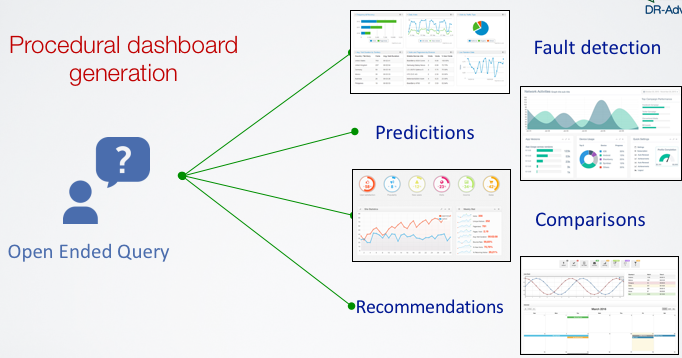
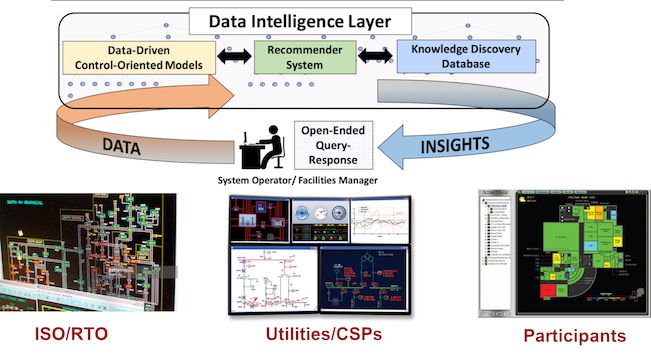
The focus of this research is on developing a taskable and interactive analytics system which is capable of answering open-ended questions. The system uses control-oreinted predictive models as a knowledge discovery database. Responses are generated in under a minute and are provided visually, and via a voice interface in a format that is both interpretable and actionable. The goal is to allow for natural language and real-time interaction of the facilities and operations managers with the underlying infrastructure system. The queries of interest can be broadly categorized as:
- Data discovery and exploration: What is happening? Example: “How much power is the building consumng right now?”.
- Reporting and analysis: Why did it happen? Example: “Why is the building consuming so much power?”.
- Predictive analytics: What could happen? Example: “How much power will the building consume tomorrow at 3pm if the zone temperature is set to 74 degree fahrenheit ?”.
- Actionable recommendations: What action should be taken? Example: “How can I reduce the current power consumption by 15 KW?”.
Interpretable control-oriented modeling
Regression trees based approaches are our choice of data-driven models for IAX. See the research on data predicitve control to know more about how regression trees can be used for control-oriented modeling. The primary reason for this modeling choice is that regression trees are highly interpretable, by design.
Interpretability is a fundamental desirable quality in any predictive model. Complex predictive models like neural-networks , support vector regression etc. go through a long calculation routine and involve too many factors. It is not easy for a human engineer to judge if the operation/decision is correct or not or how it was generated in the first place. Facilites managers and infrastructure system operators are used to a system with fixed logic and rules. They tend to prefer models that are more transparent, where it is clear exactly which factors were used to make a particular prediction. At each node in a regression tree lies a simple, if this then that, human readable, plain text rule is applied to generate a prediction which anyone can easily understand and interpret. Making machine learning algorithms more interpretable is an active area of research, one that is essential for incorporating human centric models in cyber-physical systems.
Procedural generation and open-ended queries
Facilities managers face new issues every day when running their intfrastrucutre operation via SCADA softwares. They work around the clock to keep the sytem running, but there are many factors that can get in their way:
- They have a large number of people and systems to manage.
- When a system breaks down, that becomes their first concern.
- They constantly have to balance cost efficiency with the needs of their client base.
Oftentimes, there is a lack of transparency into the system performance. Without the right information, facilties managers and operators are left to simply guess their systems’ problems. This is difficult, as it conflicts with what facilities managers need to do - keep their systems operating. They need a method to monitor operations without wasting time, money, and resources to make that happen. Another problem lies in the rigidity of the dashboards of the current energy and industrial SCADA systems; these systems are static and only provide analyses that are baked in. Operators spend significant time and cost is learning about the capabilities anf features of a new dashboard system and then are eventually limited by the capaability of the dashboard system itself. They have to become failiar with which type of information they can or cannot readily obtain.
The IAX system approaches this problem from the opposite end of the specturm.
Instead of the system operator having to learn and adapt to the capabilites of a dashboard/SCADA software, the software should adapt and learn to the system operator.
We are developing algorithms for procedural dashboard generation. Procedural generation is a method of creating data algorithmically as opposed to manually. By dynamically generating a dashboard in response to a query, the system adapts to the human operator and not vice-versa. We will also develop pipelines for streaming data ingestion that support this framework.