Related publications
- MEGA-DAgger: Imitation Learning with Multiple Imperfect ExpertsarXiv preprint arXiv:2303.00638, 2023
- A benchmark comparison of imitation learning-based control policies for autonomous racing2023 IEEE Intelligent Vehicles Symposium (IV), 2023
Overview
This project brings together two autonomous-racing studies: MEGA-DAgger, which learns from multiple imperfect experts, and a benchmark that evaluates imitation learning both on its own and as an initialization for reinforcement learning.
The descriptions below follow Xiatao Sun’s original project pages: MEGA-DAgger and Imitation Learning for Autonomous Racing.
Project video
Learning from multiple imperfect experts
Interactive imitation learning methods are often built around a single ideal expert, although practical systems may instead rely on several imperfect ones. MEGA-DAgger extends DAgger to this setting.
During dataset aggregation, it excludes unsafe examples. To handle disagreement about the action to take, it compares experts using criteria tailored to the racing scenario.
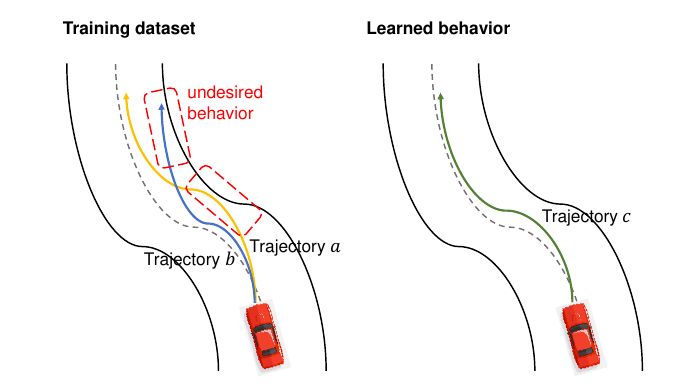
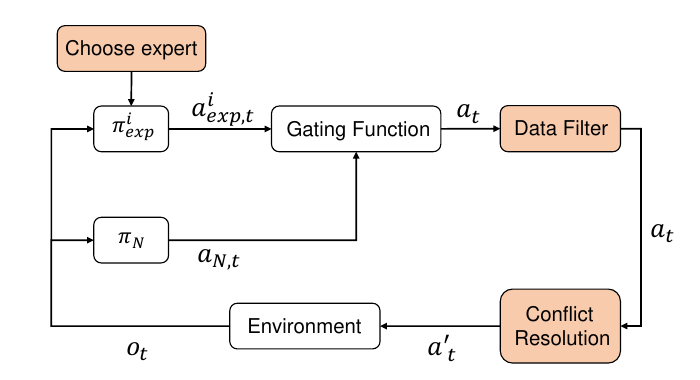
The autonomous-racing experiments show that the resulting policy can surpass the individual experts and Human-Gated DAgger.
Benchmarking imitation and reinforcement learning
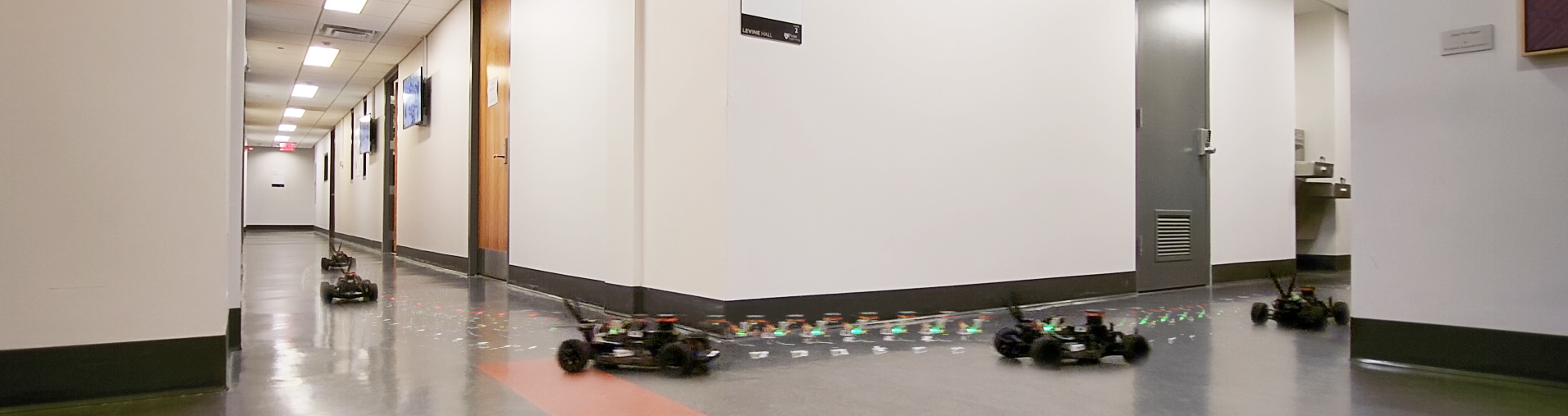
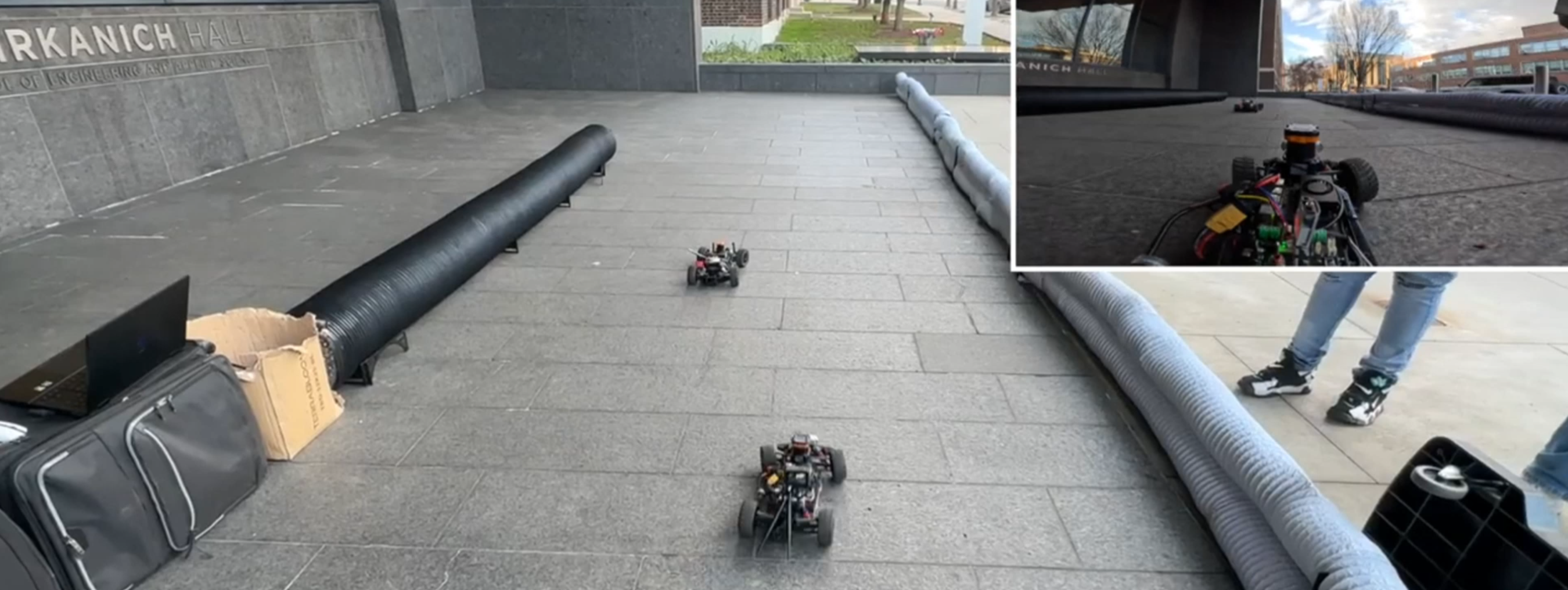
The companion study tests how imitation-based policies perform in autonomous racing, and whether they provide a useful starting point for reinforcement learning. It evaluates scaled racing vehicles in simulation and in physical experiments.
Its findings favor interactive approaches over traditional imitation methods. Their more efficient use of demonstrations also helps improve subsequent reinforcement learning. The benchmark is intended to support further research combining these approaches for autonomous racing.
Demonstrations and presentation
More videos and the original workshop presentation
MEGA-DAgger supplementary video
HG-DAgger and PPO on the physical car
First-person racing view
IROS 2022 MiniRobot Workshop slides
Workshop presentation recording
Papers and materials
- MEGA-DAgger paper · Implementation · ROS 2 deployment
- Benchmark paper, IEEE IV 2023 · BibTeX for both papers
- Original project pages: Imitation Learning for Autonomous Racing and MEGA-DAgger.
Project content, photographs, and graphics are credited to Xiatao Sun and the paper authors. Xiatao carried out this work with xLAB during his time at Penn.